Role of Emotional Intelligence in Leadership Effectiveness: Evidence from Mid-Sized Enterprises
Keywords:
Emotional intelligence, leadership effectiveness, mid-sized enterprises, Goleman’s EI model, structural equation modeling, employee engagement, self-regulation, empathyAbstract
Emotional intelligence (EI) has become a key factor in determining leadership success, especially in dynamic and resource-limited settings such as mid-sized enterprises (MSEs). This research explores how EI influences leadership outcomes in MSEs, which have 50-250 employees, within the manufacturing, services, and technology sectors in the United States, India, and Europe. Using a mixed-methods approach, the study gathered primary data through structured surveys from 620 leaders and 1,450 employees, complemented by semi-structured interviews with 45 executives. The theoretical framework was based on Daniel Goleman’s four-domain EI model, which includes self-awareness, self-management, social awareness, and relationship management.
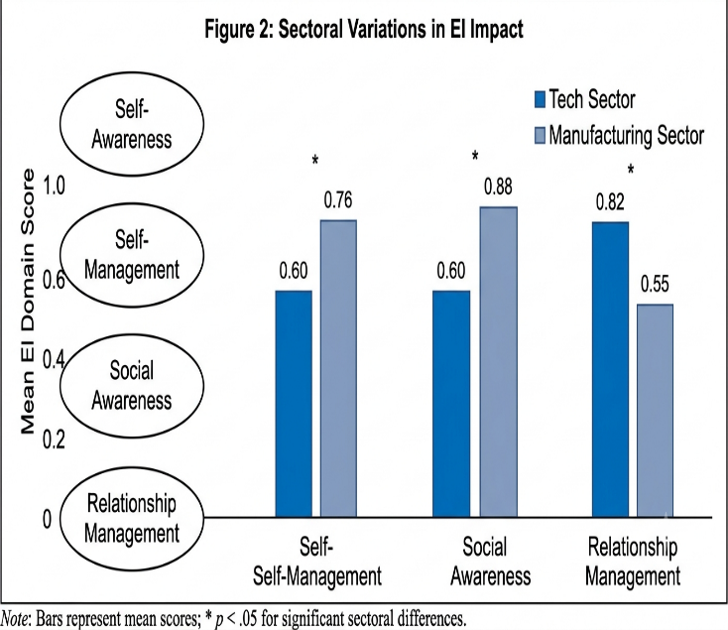
Results from Structural Equation Modeling (SEM) reveal a significant positive correlation between overall EI and leadership effectiveness (β = 0.68, p < 0.001), accounting for about 52% of the variance in outcomes like employee engagement, team performance, innovation, and organizational adaptability. Self-regulation and empathy were identified as the most influential predictors. Differences across sectors were observed, with technology companies placing greater importance on relationship management to foster innovation-driven cultures. The findings highlight EI's advantage over traditional IQ in forecasting leadership success in MSEs, where leaders frequently juggle multiple tasks amid uncertainty.
Practical recommendations include implementing targeted EI training programs, incorporating EI assessments in recruitment, and fostering cultural integration to maintain competitiveness. This study adds to the literature by offering empirical evidence from the less-explored context of MSEs during post-pandemic recovery and digital transformation challenges. Limitations and suggestions for future longitudinal research are also discussed.
References
1. Coronado-Maldonado, I., et al. (2023). Emotional intelligence, leadership, and work teams. Heliyon.
2. Gerhardt, K., et al. Emotional Intelligence and Leader Outcomes. Human Resource Development Review.
3. Goleman, D. frameworks and HBS articles.
4. Salameh-Ayanian, M., et al. (2025). The Importance of Emotional Intelligence in Managers. Administrative Sciences.
5. TalentSmart, DDI, and other statistics sources.
6. Hou, X., Li, W., & Yuan, Q. (2018). Frontline disruptive leadership and new generation employees’ innovative behaviour in China: the moderating role of emotional intelligence. Asia Pacific Business Review, 24(4), 459–471. https://doi.org/10.1080/13602381.2018.1451126
7. Alharbi, R., & Alnoor, A. (2022). The influence of emotional intelligence and personal styles of dealing with conflict on strategic decisions. PSU Research Review, 8(2), 443–454. https://doi.org/10.1108/prr-08-2021-0040
8. Abdullahi, A. Z., Anarfo, E. B., & Anyigba, H. (2020). The impact of leadership style on organizational citizenship behavior: does leaders’ emotional intelligence play a moderating role? Journal of Management Development, 39(9/10), 963–987. https://doi.org/10.1108/jmd-01-2020-0012
9. Ye, L., Zhang, N., Zhang, J., Sun, H., Chu, X., Zheng, X., & Gong, R. (2024). Leader emotional intelligence and employee work performance: A moderated mediation model. Social Behavior and Personality: An International Journal, 52(11), 1–11. https://doi.org/10.2224/sbp.14000
10. Xu, F. (2025). The Effect of Transformational Leadership and Organizational Justice on Job Satisfaction: The Mediating Role of Emotional Labor. Pakistan Journal of Life and Social Sciences (PJLSS), 23(1). https://doi.org/10.57239/pjlss-2025-23.1.00699
11. Al Mamun, A., Ibrahim, M. D., Yusoff, M. N. H. B., & Fazal, S. A. (2018). Entrepreneurial Leadership, Performance, and Sustainability of Micro-Enterprises in Malaysia. Sustainability, 10(5), 1591. https://doi.org/10.3390/su10051591
12. Arham, A. F., Norizan, N. S., Arham, A. F., & Muenjohn, N. (2024). Construct Development for Resilient Leadership Model (Rel Model): A View from Malaysian SMEs. International Journal of Organizational Leadership, 0(0), 251–274. https://doi.org/10.33844/ijol.2024.60408
13. Demirova, S., & Yorgova, J. (2024). Assessing Emotional Intelligence in Engineering Managers in Bulgaria and its Impact on Team Effectiveness. Economics Ecology Socium, 8(4), 66–77. https://doi.org/10.61954/2616-7107/2024.8.4-6
Additional Files
Published
Issue
Section
License
Copyright (c) 2026 International Journal of Fundamental Research & Development

This work is licensed under a Creative Commons Attribution 4.0 International License.