Study of Thermal Transport Mechanisms in Low-Dimensional Materials for Next-Generation Electronics
Keywords:
Thermal transport, low-dimensional materials, phonon scattering, graphene, molybdenum disulfide, silicon nanowires, time-domain thermoreflectance, Boltzmann transport equation, nanoelectronics thermal managementAbstract
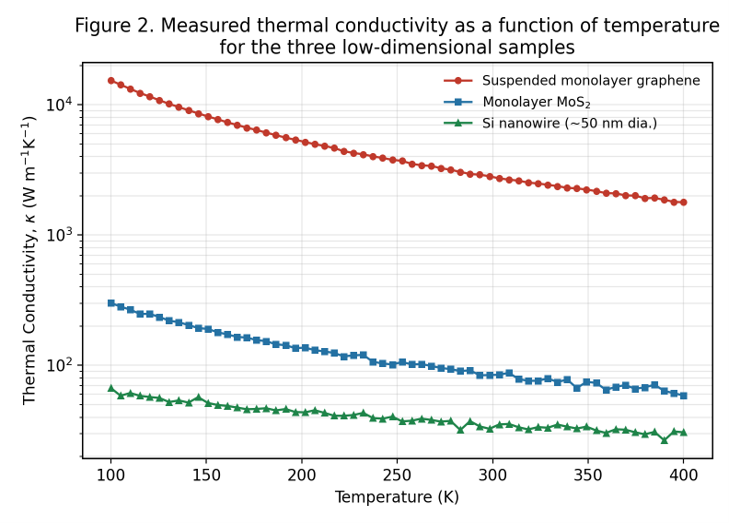
In contemporary electronics, effective thermal management has emerged as a primary design constraint due to the reduction of device sizes to the nanometre scale and the increase in power densities. In materials with low dimensions, such as graphene, transition-metal dichalcogenides (TMDs), and semiconductor nanowires, heat is mainly transported by phonons. These phonons experience significant alterations in their transport due to boundary scattering, reduced dimensionality, and confinement effects, which do not have direct counterparts in bulk crystals. This study offers an integrated experimental and analytical examination of thermal transport in three typical low-dimensional systems: suspended monolayer graphene, few-layer molybdenum disulfide (MoS2), and silicon nanowires with varying diameters. The methods employed include time-domain thermoreflectance (TDTR), micro-Raman thermometry, and suspended micro-bridge resistance thermometry. The thermal conductivities measured at room temperature were 2650 ± 320 W m-1K-1 for suspended monolayer graphene, 84 ± 9 W m-1K-1 for five-layer MoS2, and 34 ± 4 W m-1K-1 for silicon nanowires with a 50 nm diameter. These values are reduced by one to two orders of magnitude compared to their bulk crystal counterparts. Measurements taken across temperatures ranging from 100 K to 400 K, along with a phonon Boltzmann transport equation (BTE) analysis using the relaxation-time approximation, show that Umklapp scattering is predominant at high temperatures, while boundary and layer-number-dependent scattering influence the trends at low temperatures and varying sizes. The reconstruction of the cumulative thermal conductivity accumulation function indicates that phonons with mean free paths between 100 nm and 1 micrometre play a significant role in heat conduction in graphene, suggesting nanostructuring strategies for thermal management. The findings are analyzed in relation to thermal bottlenecks in transistors and interconnects based on two-dimensional materials, and guidelines for designing heat-spreading layers in future electronic packages are suggested. This research provides quantitative benchmarking data and a validated modeling framework to support the thermal-aware design of nanoelectronic devices.
References
[1] Balandin, A. A., Ghosh, S., Bao, W., Calizo, I., Teweldebrhan, D., Miao, F., & Lau, C. N. (2008). Superior thermal conductivity of single-layer graphene. Nano Letters, 8(3), 902–907.
[2] Ghosh, S., Calizo, I., Teweldebrhan, D., Pokatilov, E. P., Nika, D. L., Balandin, A. A., Bao, W., Miao, F., & Lau, C. N. (2008). Extremely high thermal conductivity of graphene: Prospects for thermal management applications in nanoelectronic circuits. Applied Physics Letters, 92(15), 151911.
[3] Li, D., Wu, Y., Kim, P., Shi, L., Yang, P., & Majumdar, A. (2003). Thermal conductivity of individual silicon nanowires. Applied Physics Letters, 83(14), 2934–2936.
[4] Hochbaum, A. I., Chen, R., Delgado, R. D., Liang, W., Garnett, E. C., Najarian, M., Majumdar, A., & Yang, P. (2008). Enhanced thermoelectric performance of rough silicon nanowires. Nature, 451(7175), 163–167.
[5] Yan, R., Simpson, J. R., Bertolazzi, S., Brivio, J., Watson, M., Wu, X., Kis, A., Luo, T., Hight Walker, A. R., & Xing, H. G. (2014). Thermal conductivity of monolayer molybdenum disulfide obtained from temperature-dependent Raman spectroscopy. ACS Nano, 8(1), 986–993.
[6] Jo, I., Pettes, M. T., Kim, J., Watanabe, K., Taniguchi, T., Yao, Z., & Shi, L. (2013). Thermal conductivity and phonon transport in suspended few-layer hexagonal boron nitride. Nano Letters, 13(2), 550–554.
[7] Cahill, D. G. (2004). Analysis of heat flow in layered structures for time-domain thermoreflectance. Review of Scientific Instruments, 75(12), 5119–5122.
[8] Sood, A., Xiong, F., Chen, S., Wang, H., Selli, D., Zhang, J., McClellan, C. J., Sinclair, R., Pop, E., Asheghi, M., & Goodson, K. E. (2019). An electrochemical thermal transistor. Nature Communications, 10, 4325.
[9] Chen, X., Han, Z., & Wu, X.-F. (2020). Thermal conductivity of monolayer molybdenum disulfide: Full quantum treatment. Journal of Physics: Condensed Matter, 32(8), 083001.
[10] Nika, D. L., & Balandin, A. A. (2017). Phonons and thermal transport in graphene and graphene-based materials. Reports on Progress in Physics, 80(3), 036502.
[11] Chen, G. (2005). Nanoscale Energy Transport and Conversion: A Parallel Treatment of Electrons, Molecules, Phonons, and Photons. Oxford University Press.
[12] Regner, K. T., Sellan, D. P., Su, Z., Amon, C. H., McGaughey, A. J. H., & Malen, J. A. (2013). Broadband phonon mean free path contributions to thermal conductivity measured using frequency domain thermoreflectance. Nature Communications, 4, 1640.
[13] Yang, F., & Dames, C. (2013). Mean free path spectra as a tool to understand thermal conductivity in nanostructures. Physical Review B, 87(3), 035437.
[14] Seol, J. H., Jo, I., Moore, A. L., Lindsay, L., Aitken, Z. H., Pettes, M. T., Li, X., Yao, Z., Huang, R., Broido, D., Mingo, N., Ruoff, R. S., & Shi, L. (2010). Two-dimensional phonon transport in supported graphene. Science, 328(5975), 213–216.
[15] Liu, J., Choi, G.-M., & Cahill, D. G. (2014). Measurement of the anisotropic thermal conductivity of molybdenum disulfide by the time-resolved magneto-optic Kerr effect. Journal of Applied Physics, 116(23), 233107.
[16] Pop, E., Sinha, S., & Goodson, K. E. (2006). Heat generation and transport in nanometer-scale transistors. Proceedings of the IEEE, 94(8), 1587–1601.
[17] Luo, T., & Chen, G. (2013). Nanoscale heat transfer — from computation to experiment. Physical Chemistry Chemical Physics, 15(10), 3389–3412.
[18] Mounet, N., & Marzari, N. (2005). First-principles determination of the structural, vibrational and thermodynamic properties of diamond, graphite, and derivatives. Physical Review B, 71(20), 205214.
[19] Zhang, X., Sun, D., Li, Y., Lee, G.-H., Cui, X., Chenet, D., You, Y., Heinz, T. F., & Hone, J. C. (2015). Measurement of lateral and interfacial thermal conductivity of single- and bilayer MoS2 and MoSe2 using refined optothermal Raman technique. ACS Applied Materials & Interfaces, 7(46), 25923–25929.
[20] Sadeghi, M. M., Pettes, M. T., & Shi, L. (2012). Thermal transport in graphene. Solid State Communications, 152(15), 1321–1330.
Additional Files
Published
Issue
Section
License
Copyright (c) 2026 International Journal of Fundamental Research & Development

This work is licensed under a Creative Commons Attribution 4.0 International License.